Ben
Bringing clarity and control to the complexity of global employee benefits
The story
Ben was founded on a simple but powerful realisation: the way global companies manage employee benefits is fundamentally broken.
For large organisations operating across multiple countries, benefits are complex by design, shaped by different regulations, providers and local expectations. Yet the systems used to manage them have failed to keep pace. Fragmented tools, manual processes and disconnected data have made benefits difficult to manage, costly to administer and hard for employees to access.
Having experienced these challenges firsthand, co-founders Sebastian Fallert and David Duckworth set out to rebuild the system from the ground up.
Ben brings together employers, employees, brokers and providers into a single, connected platform. By consolidating benefits into one place, the company enables organisations to manage complexity at scale, providing a clear view of costs, improving operational efficiency and creating a more seamless experience for employees.
At the core of the platform is an AI-native approach that automates administrative workflows and delivers personalised guidance to employees. This not only reduces the burden on HR teams, but helps ensure that benefits are understood, accessible and used effectively.
Since launching in 2019, Ben has scaled rapidly, supporting employees in more than 140 countries and working with global organisations including Deliveroo, Zalando and Octopus Energy. As demand for more flexible, scalable benefits infrastructure continues to grow, the company has expanded its presence across Europe and North America while continuing to invest in its product and go-to-market capabilities.
At its core, Ben is not just simplifying benefits administration.
It is building the infrastructure that allows global companies to better support their people, transforming a fragmented, inefficient system into one that is connected, transparent and designed for modern workforces
Why we invested
Ben stood out as a company tackling a deeply complex and under-served problem at global scale. Employee benefits are a significant cost for enterprises, yet the infrastructure supporting them has remained fragmented, manual and difficult to manage, particularly across multiple markets.
What impressed us was the team’s ability to re-architect this system from first principles. Rather than layering onto legacy tools, Ben has built a modular, AI-enabled platform designed specifically for global complexity, enabling employers to manage diverse benefits, regulations and providers through a single, unified system.
Combined with strong early traction among large enterprises and a clear vision to become the underlying infrastructure for benefits management, Ben demonstrated both the technical capability and commercial momentum to challenge established incumbents and define a new category.
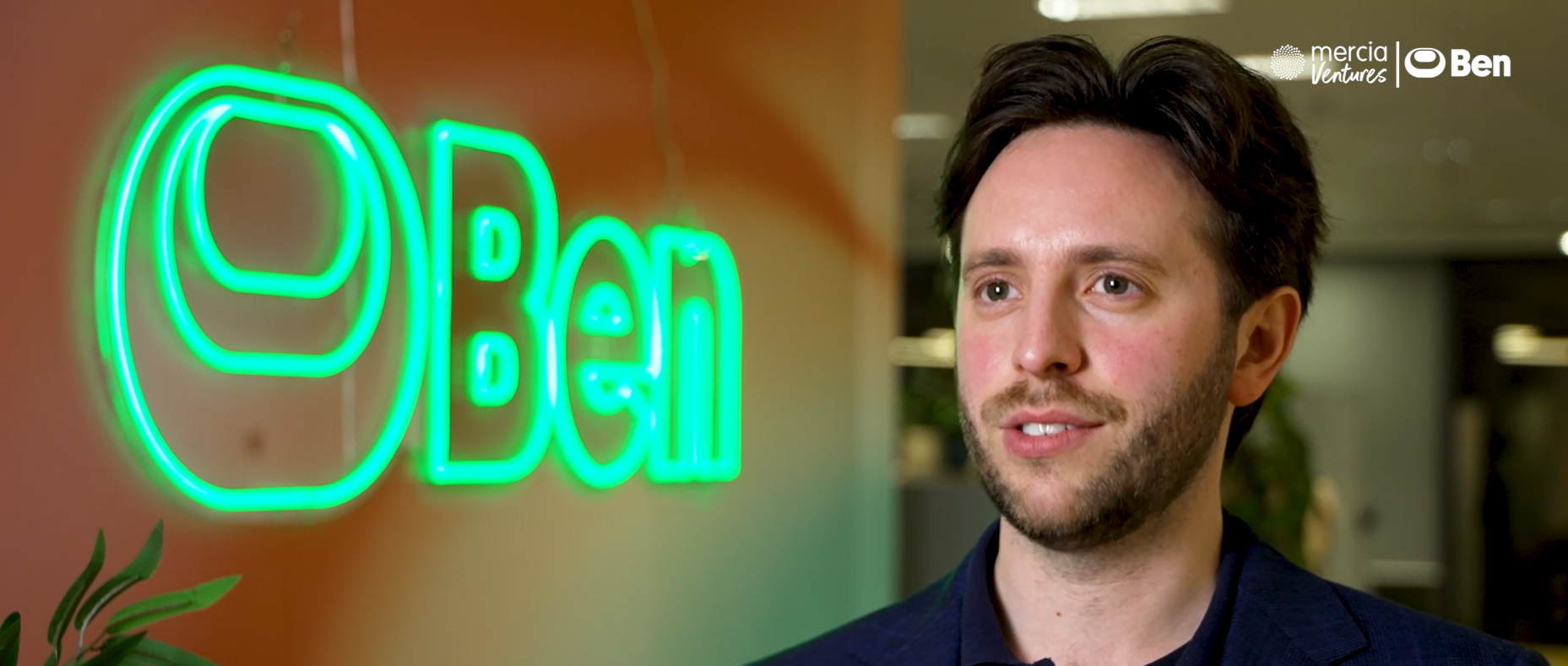
Watch: Founder conversations
Mercia Ventures led Ben’s $27.5m Series B funding in December 2025, in which was their largest investment to date, backing a founder-led business that is rethinking how employee benefits work for global enterprises.
Built in London, Ben is taking on legacy platforms with an AI-native approach that cuts through benefits complexity by consolidating benefits into a single platform, connecting employers, employees, brokers and providers.
Learn more about the business with CEO and co-founder, Seb Fallart with the thoughts of Mercia Ventures Investment Manager, Johnathan Kruger.
Seb Fallot, Ben founder:
Mercia Ventures – I would almost say it was sort of love at first sight.
So my co-founder David and I, we connected in 2019 and we were looking at the future of work and like all the mega trends out there. And we found that compensation is actually a really interesting topic, specifically benefits, because in many ways it’s the most complex part of compensation and like really fell in love with the space.
And once we started digging in, we realised especially global benefits for large companies are complex. And believe it or not, most companies don’t have a software solution to do this. And so that was really the genesis of we’ve built, we architected the system from the ground up to be suitable for global benefits. Meaning everything is built in a very modular fashion.
We sometimes call it Lego for benefits. So from the Colombian health insurance to the Singaporean life insurance to the UK pension, it’s all a bunch of building blocks, both on the user interface side for the employees, but also in the back office in terms of payroll deductions and tax regulations and things like that. And that’s really the biggest differentiator where we can also using AI in order to generate considerations and understand local customs and regulations just go to market much, much quicker and actually go further than any of the other platforms in delivering for our customers. The history of the company is really was around payment cards.
It was a very happy clappy product. Why don’t we go to companies and sell them these payment cards where they can put money on and then their employees can go and maybe, buy a sandwich or pay for their supplements or something like that wellbeing. And it’s very quickly moved into a fully fledged benefits platform because companies were coming back and saying, we love what you’re doing, we love your approach and your vision, but please can you take care of our pension, of our health insurance, of our life insurance and ideally globally. And that’s really been the big transition from smaller companies and less complexity to the whole bouquet of benefits globally and with some of the largest companies on the planet.
So for example, we’re just onboarding one of the world’s largest airlines, which is super interesting. It’s almost 50,000 people we’re talking pilots, package handlers, technicians check-in staff. So like a very diverse workforce, many of them without a laptop, like given the nature of their work, they’re more on their mobile phone and they all have very different benefits. If you are an airline pilot flying, around the globe, you’ll get a different package from somebody working in the back office for example. And so that’s a really good example of like where we tame the complexity and provide an amazing experience for the employees to pick and mix from the offering of the company and make sure they get the most value out of their compensation.
Jonathan Kruger, Mercia Ventures investor:
Benefits management is an industry sort of controlled by four or five very large global players, who have historically underinvested in software capabilities and sort of frontend UX. Ben have, completely from scratch built the product that the HR teams love to use. You know, for a new business to come in, build something completely from scratch, very difficult to do considering Seb and David don’t have backgrounds in the space and this is a real industry where earning trust and credibility amongst HR professionals is incredibly difficult. It’s something they have clearly been able to do and evidenced by the sorts of accounts that they’ve been winning over the last couple of years since COVID, employee benefits is becoming more and more important as an offering for large employers as a, as a way to sort of attract and retain staff.
And what Ben really did that excited us, was know they built essentially an orchestration layer, which enables large employees to manage complex, benefits offerings globally
Seb Fallot, Ben founder:
Obviously so grateful for the backing of a new investor and also for existing investor base. We are building for the long run, you know, will be this country will be run for decades and decades going after a huge opportunity.
So having an investor who really shares our vision for where we want to take this market and has unshakable conviction and that it can be done is the most important thing because ultimately nothing is ever and up until the ride, like there’ll be amazing times and there’ll be tough times. And having an investor who’s there supportive and like believing, in the ultimate vision is incredibly important.
In many ways we want to be the infrastructure for benefits. We want to be the canonical solution because today there is none. If I asked 10 chief people officers, name the top brand in benefits management, what’s the solution that you go for? If you just want the problem solved, they don’t know. And if I could turn around in, five years time and like survey them and half of them said it’s been for benefits, obviously, I think that’s the future that we’ve be incredibly excited about.