Scaling teams, hiring and leadership
A practical guide for growing businesses
From first hires to building leadership teams – how to structure, hire and lead as your business scales.
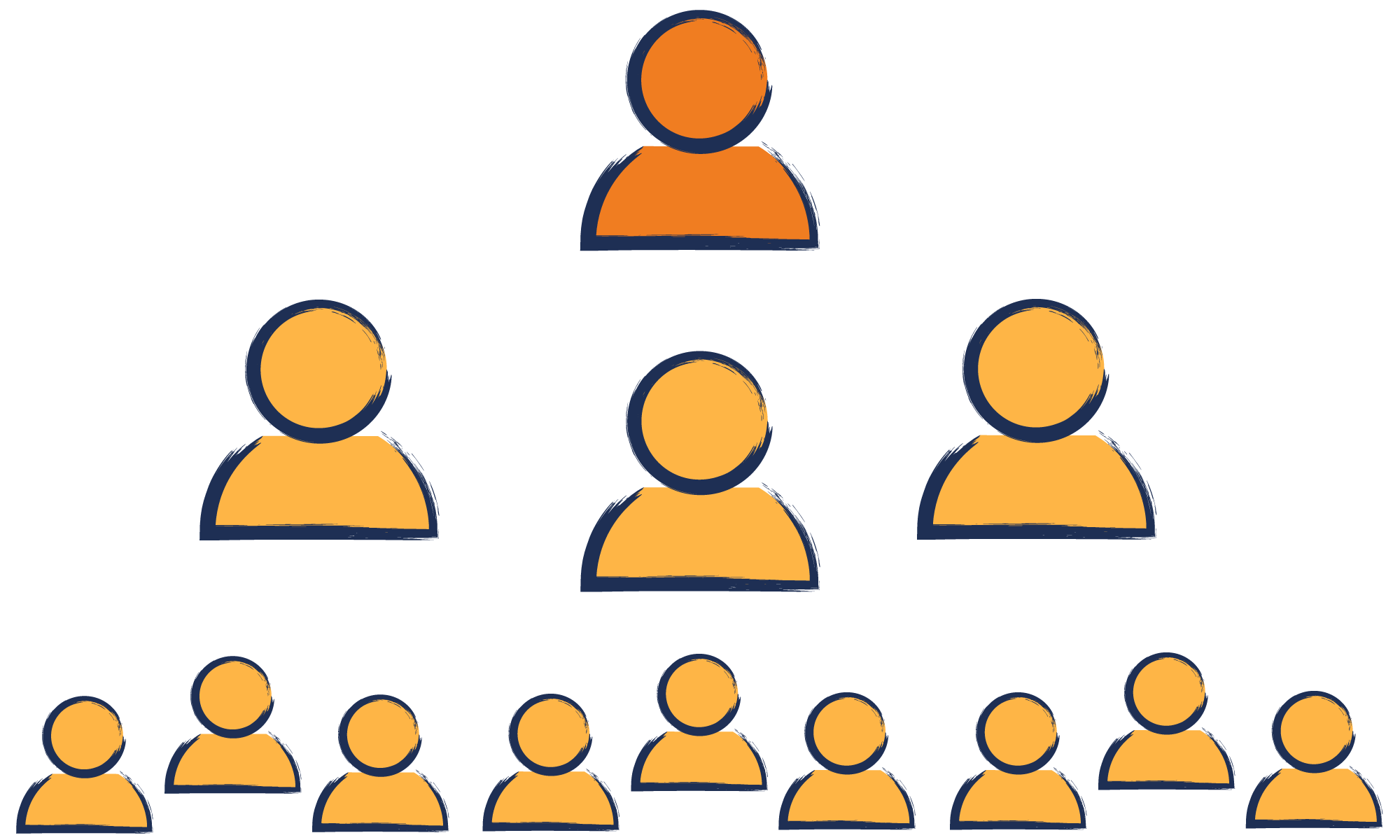
What does “scaling a team” actually mean?
Scaling a team is not simply about hiring more people. It is about building the right structure, capability and leadership to support growth without slowing the business down.
At different stages, team needs evolve significantly. What works for a team of three will not work for a team of twenty. Founders must balance speed with structure, ensuring the organisation grows in a way that supports long-term performance.
Hiring too early can create unnecessary complexity, while hiring too late can restrict growth. The challenge is knowing what to prioritise, when.
The team scaling journey: A visual framework
As businesses grow, team structure and leadership expectations evolve. While every journey is different, most high-growth companies move through recognisable stages.
Early stage (0-10 people)
Typical focus: Building the core team
What matters most: Versatility, pace and alignment
Common founder mistake: Hiring specialists too early before roles are clearly defined or needed
At this stage, teams are small and roles are fluid. Founders are heavily involved in all areas of the business, and early hires need to be adaptable, comfortable with ambiguity and able to take ownership.
Hiring is often focused on generalists who can contribute across multiple functions while the business defines its direction.
Growth stage (10-30 people)
Typical focus: Introducing structure and specialisation
What matters most: Clarity of roles and early leadership
Common founder mistake: Holding onto too much control and delaying delegation, slowing decision-making and team development
As the business grows, roles become more defined and functional expertise becomes more important. Founders begin to delegate responsibility and introduce initial layers of management.
This is often the point where early leadership capability becomes critical, particularly in areas such as sales, marketing and operations.
Scale-up stage (30-100 people)
Typical focus: Building leadership and operational consistency
What matters most: Strong management and communication
Common founder mistake: Promoting high-performing individuals into leadership roles without the support or training needed to succeed
At this stage, the business requires clear structure, consistent processes and stronger internal communication. Founders are no longer involved in day-to-day execution and must shift towards leading through others.
Hiring focuses on experienced managers and leaders who can build teams, not just deliver individually.
Leadership stage (100+ people)
Typical focus: Strategic leadership and organisational design
What matters most: Governance, culture and long-term planning
Common founder mistake: Failing to evolve leadership style, leading to misalignment and inefficiencies as the organisation grows.
As organisations scale further, leadership becomes more strategic. Founders focus on vision, culture and long-term direction, supported by a senior leadership team.
There is increased emphasis on governance, performance management and organisational alignment.
Core questions founders ask when scaling a team

When should I make my next hire?
Hiring should be driven by clear business need and future growth, not short-term pressure. The right time to hire is when additional capacity or expertise will unlock meaningful progress, whether that is revenue growth, product development or operational efficiency.
Explore how to assess readiness

What roles should I prioritise first?
Early hires should address the most critical constraints in the business. This often includes revenue generation, product development or operational delivery. Prioritisation should be based on where additional capability will have the greatest impact.
Read how to prioritise hires
When do I need senior leadership?
Senior hires become important when the business requires repeatable processes, team management and strategic oversight. Bringing in leadership too early can be costly, but delaying too long can limit growth.
Understanding your first senior leader

How do I build a strong culture?
Culture is shaped by behaviours, not statements. Founders play a central role in setting expectations, communication style and values. Consistency in decision-making and leadership behaviour is key to building a strong, scalable culture.
Learn how to build culture
When should I bring in advisors or non-execs?
External advisors and non-executive directors can provide valuable perspective, challenge and experience. They are particularly useful when navigating new stages of growth or complex strategic decisions.
See when to introduce external support
How do I transition from founder to leader?
As teams grow, founders must shift from doing to enabling. This includes delegating effectively, setting direction and supporting others to perform. Leadership development is often one of the most significant personal transitions in the scaling journey.
Explore evolving leadership
Not sure which question is most relevant?
Team building is rarely linear. Use the framework above to identify your current stage or download the scaling checklist to assess your next steps.
What investors typically look for
Investors look beyond the founding team to assess whether the business has the capability to scale.
This includes:
- strength across key functions (product, commercial, operations)
- ability to execute consistently
- evidence that the team can grow with the business
As companies scale, depth beyond the founders becomes increasingly important.
Leadership and decision-making
Investors assess:
- clarity of thinking and decision-making
- ability to prioritise effectively
- willingness to adapt as the business evolves
Strong leadership is often a key differentiator in high-growth businesses.
Hiring strategy and discipline
Investors want to see that hiring is:
- deliberate and aligned to business needs
- focused on impact rather than headcount growth
- supported by clear roles and responsibilities
A structured approach to hiring suggests the business can scale sustainably.
Ability to attract and retain talent
Investors look for:
- evidence that strong candidates are joining the business
- low levels of unwanted churn
- a clear employee value proposition
The ability to attract and retain talent is a strong signal of long-term potential.
Culture and alignment
Investors assess:
- alignment across the team
- clarity of purpose and values
- consistency in how the business operates
A strong culture supports performance, adaptability and resilience.
Leadership scalability
Investors look for:
- willingness to delegate and build leadership layers
- ability to step back from day-to-day execution
- openness to external support and challenge
Leadership scalability is critical to sustaining growth over time.
Governance and structure
This includes:
- clear reporting structures
- defined roles and accountability
- early signs of board or advisory support
Strong governance provides confidence that the business can manage complexity as it scales.
While team and leadership are just one part of the investment decision, they are often one of the most influential. Businesses with strong, aligned and scalable teams are typically better positioned to execute and deliver long-term value.
Key takeaways
- Hiring should be driven by future growth, not just current pressure.
- Team structure needs to evolve alongside the business.
- Leadership is a skill that develops over time and requires active focus.
- Strong teams are built on clarity, accountability and communication.
- External support and perspective can accelerate team and leadership development.