Market opportunity & strategic context
Market size & growth
- The global spine hardware market was valued at +$10bn in 2024, with the US accounting for 71% of this total.
- The anterior approaches (ALIF, Lateral, Oblique) targeted by Axis represent a $1bn market in the US and $2.5bn globally.
- US breakdown: ALIF = $500m, Lateral = $350m, Oblique = $150m.
The challenges with the traditional, commoditised implants
- Traditional monobloc implants require brute force to insert the implant. The resulting damage to the endplates causes 23% of cases to end in spine cage subsidence. This leads to increased pain, reduced function and poor spinal alignment, often requiring revision surgery to fix.
- These monobloc implants are largely commoditised, with pricing pressure from the market. This combined with the high number of SKUs required to offer the range of shapes and sizes needed makes them a low margin asset.
- The new wave of robotic surgery struggles to use these traditional implants given the computer-generated patient-customised implant plans require flexibility in shape and size.
Axis’ implants
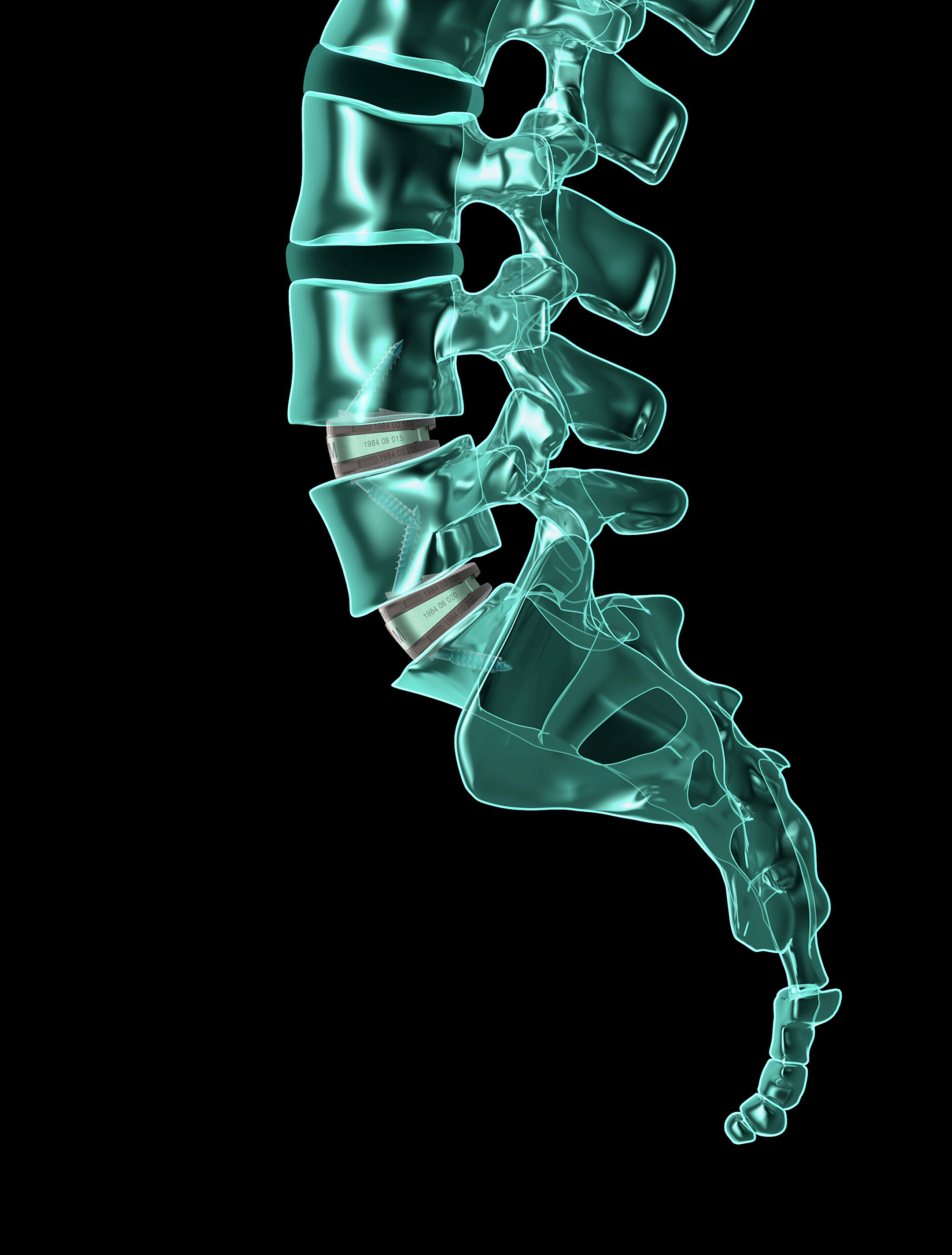
- Axis’ modular cage design and delicate insertion avoids damaging the endplates or risking subsidence. As a result, after 200+ cases Axis is yet to see a single case of subsidence, and all achieving excellent spinal alignment.
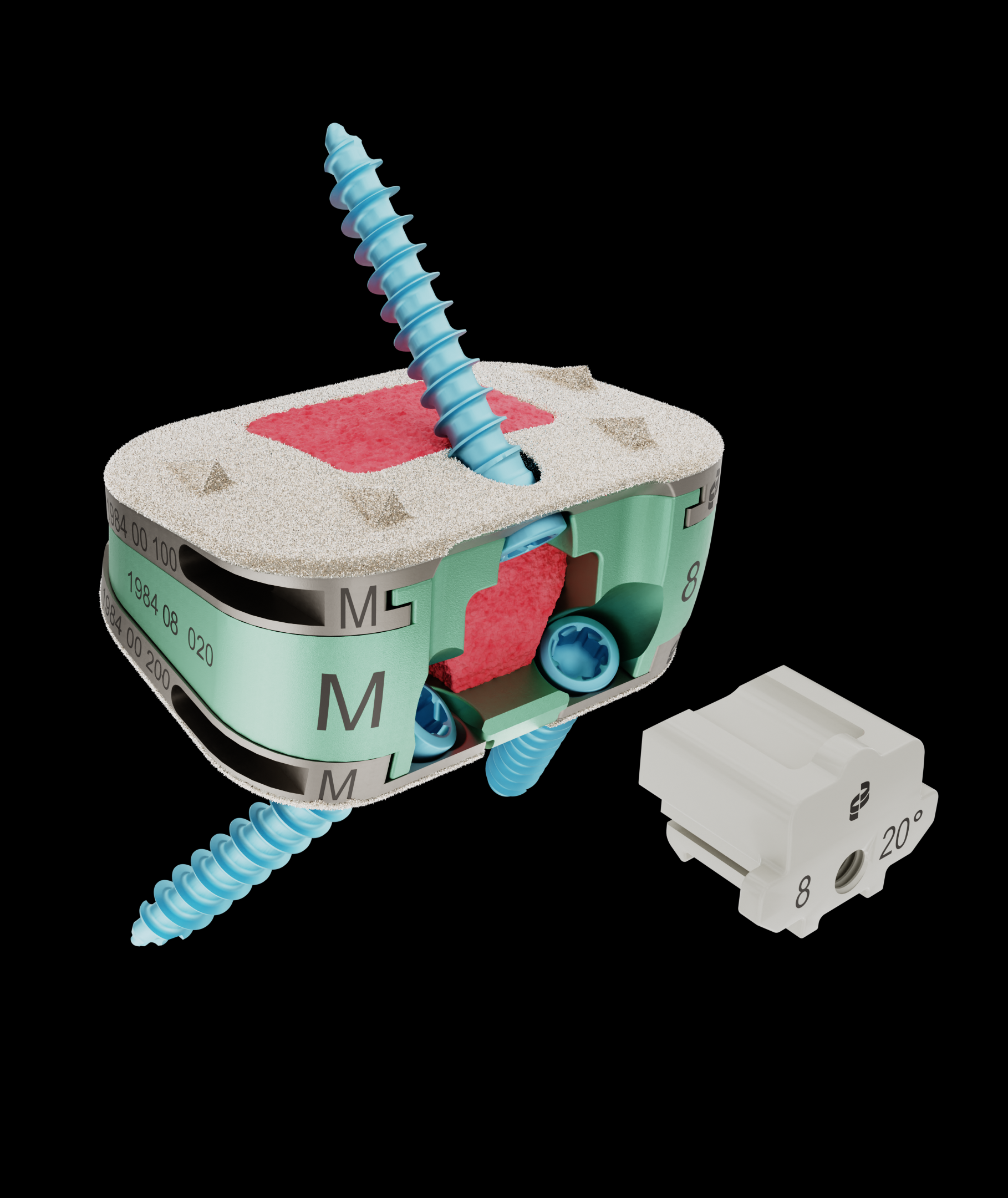
- The modular design of the cage means surgeons can create a shape and size of implant tailored to the patients’ needs, but with just a fraction of the number of implant SKUs to achieve the same number of angle options as traditional cages. This unlocks inventory efficiencies of up to 80%.
- This same modular design also makes the Axis implants very attractive to robotic surgery.
Achievements to date
Redefining spinal fusion: proven results, zero alignment loss
- Product: Axis has developed a modular ALIF cage, enabling delicate insertion, improved patient outcomes and cost savings for hospitals. Lateral and Oblique products are in development.
- Commercial Milestones:
- 200+ ALIF cage implanted.
- So far used by 20 different surgeons with many more in the pipeline.
- c.$2m cumulative revenues since launch.
- 16 hospital approvals
- Clinical outcomes:0% implant subsidence with maintained alignment correction through longest follow-up1 vs. 6 to 23.1% for traditional ALIF cages2
1) Comparison of Modular and One-Piece ALIF Implants: Radiographic Analysis of Subsidence and Segmental Lordosis Outcomes. Guyer RD et al. ISASS2025 ePoster
2) Subsidence of Spinal Fusion Cages: A Systematic Review. Parisien A et al. In J Spine Surgery 2022.
Strategic positioning
- Axis is positioned at the intersection of clinical innovation and commercial scalability, with a differentiated product suite that addresses unmet needs in spinal alignment and hospital economics.
- The modular design and clinical performance of Axis implants are resonating with both surgeons and hospital decision-makers.
- Strategic acquirors have signaled clear interest.
Growth & exit pathways
- Key objective: Continue commercial traction.
- Product pipeline: developing Lateral and ALIF products.
- Exit readiness: Ongoing engagement with strategic acquirors, robust clinical data, and a clear plan for scaling distributor and surgeon adoption.
Why Axis Spine?
- Clinical differentiation: Superior patient outcomes and surgeon advocacy.
- Commercial momentum: Growing user base, strong hospital traction, and increasing sales velocity.
- Scalable platform: Modular technology with expansion potential across multiple spinal procedures.
- Strategic fit: Fills portfolio gaps for leading acquirors, complements enabling technologies (robotics, navigation, AI planning).
- Experienced team: Leadership with a track record of successful exits in orthopaedics and MedTech.
Get in touch
If you would like more information about Axis Spine or would like to meet up at NASS in Denver (November 14-16), please email us to get in touch.